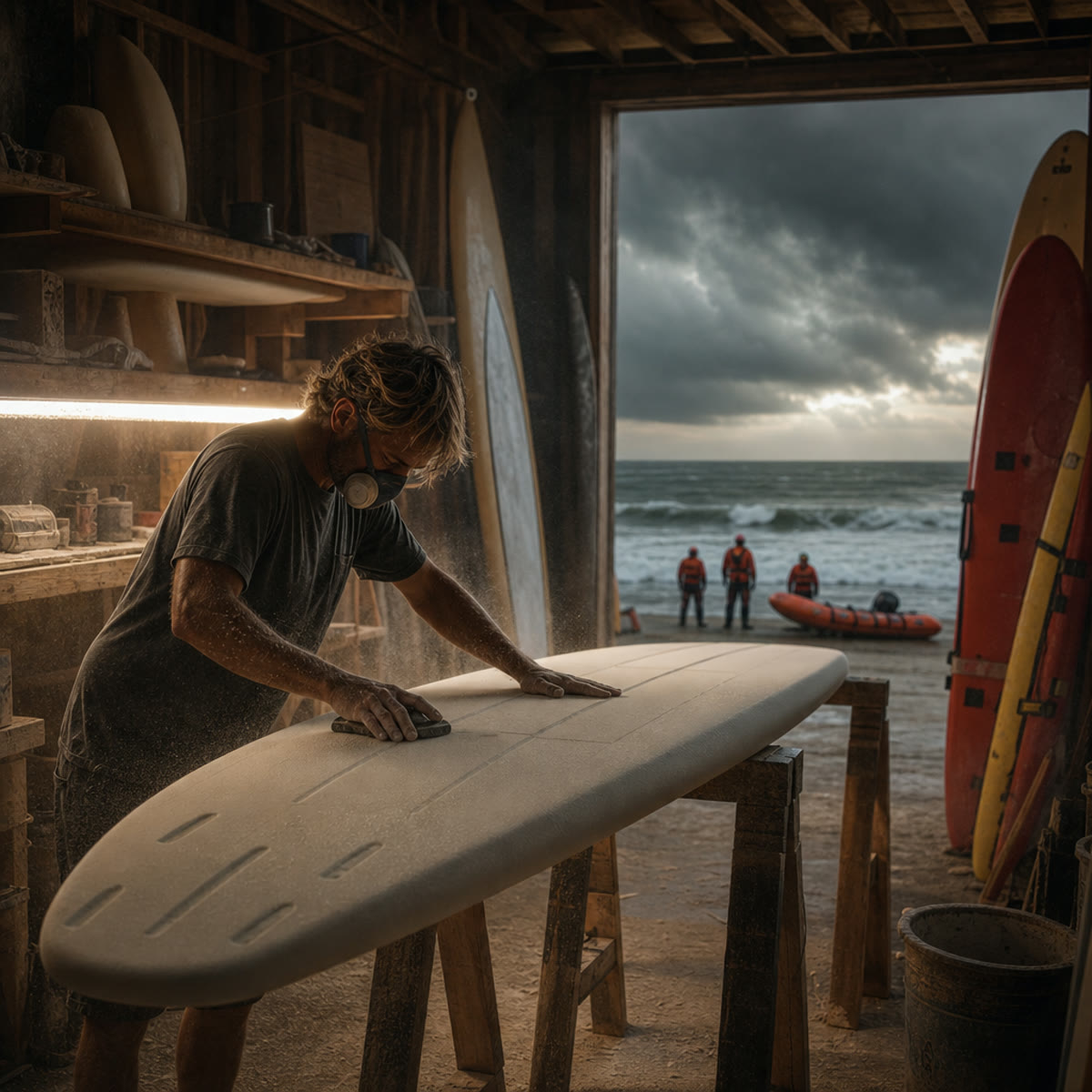
The strongest Galaxy song this week was not the loudest headline. It was the one with the best physics: a person in a shop shaping foam and resin before the ocean calls for it. "Boards for the Break" won because the music had to solve the same problem as the story. How do you make preparedness sound urgent without making it frantic? How do you make handwork feel heroic without turning it into bumper-sticker uplift?
The pipeline's final version scored 93 because it resisted article recap. The topic was a Port Salerno board shaper building rescue boards for St. Lucie County Ocean Rescue. The song became something larger and stranger: prepared mercy, a handmade object waiting quietly for a future panic. That is a very good music-theory problem. The arrangement has to hold stillness and danger at once.
That is why this piece earns the weekly deep dive over bigger stories from the same run window. It stacks folk economy, grunge dynamics, country-blues modality, and work-song function into one coherent emotional machine.
1. Dynamics and Structure: Quiet Labor, Loud Water
The structure is classic but not lazy: verse, pre-chorus, chorus, verse, bridge, guitar solo, final chorus. What makes it work is the directional pressure inside that familiar frame. Verse one lives at the workbench. The pre-chorus narrows the camera to the board's shape. The chorus throws the object into public use. Verse two tests it against fatigue and panic. The bridge turns craft into moral philosophy. The final chorus expands because the board is no longer just equipment; it has become a communal promise.
That is the right kind of escalation. Not more plot. More consequence.
From the "Smells Like Teen Spirit" lesson, we learned that quiet-loud dynamics are not merely volume changes; they are emotional architecture. Nirvana's template made the transition itself the hook. Here, the folk-grunge version is less teenage detonation and more tide-line tension: brushed, close, almost domestic verses; a chorus that opens the window and lets the red lights in; a final chorus that adds communal weight instead of simply turning the amp up.
Verse: close acoustic pulse, brushed kit, dry baritone, shop-scale detail

Pre-Chorus: narrowed rhythm, suspended breath, small melodic lift

Chorus: wider harmony, electric swell, group response, rescue-command energy

Bridge: stripped-back thesis, space around the vocal

Final Chorus: extra lift, wider image, communal landing
The Frontiers commentary on musical reward is useful here because it frames pleasure as a prediction game: listeners build expectations from style, form, and repetition, then feel the charge when the song confirms or bends them. "Boards for the Break" uses that expectation cleanly. Once the chorus teaches the rescue command, every return feels less like repetition and more like readiness.
2. Instrumentation: Acoustic Tools, Electric Weather
The production brief called for raw folk-grunge, fingerpicked acoustic pulse, brushed snare, low electric swells, baritone vocal, coastal work-song pulse, and rough-hewn harmonies. That is exactly the right palette because the story is about a physical object. Gloss would betray it.
The acoustic guitar is the workbench: wood, wire, repeated hand movement. Brushed drums keep the track from marching too hard; they feel like sandpaper, tide-wash, and shop dust. The bass should be almost stubborn, alternating root and fifth like a body returning to a task. The electric guitar should not dominate the arrangement early. It should arrive as weather: low swells, storm pressure, a little grunge salt in the corner of the room.
The Smithsonian Folkways bluegrass lesson on "chop" is a useful model even though this is not a straight bluegrass song. In bluegrass, the bass can hold the downbeat while mandolin or another instrument snaps the upbeat; that division creates drive without needing a full drum kit. "Boards for the Break" borrows the principle, not the costume. Downbeat = craft. Upbeat = water. The groove is the board being built before the emergency.
Acoustic guitar: the hand, the bench, the human scale.
Brushed snare: motion without heroics; urgency without panic.
Low electric swells: the break entering the room before the lyric names it.
Rough harmonies: the rescue crew implied by sound, not explained by exposition.
This also connects to the Dolly Parton deep dive: Appalachian-rooted songwriting often lets simple chords, drones, and hand rhythms do the heavy emotional lifting. Dolly's "9 to 5" lesson gave us a sharper version of the same idea: find the sound inside the story. For that song it was office machinery; for this one it is sanding, surf, and the pulse of a board moving through bad water.
3. Vocal Approach: Baritone Witness, Not Lifeguard Commercial
The vocal needed to be plainspoken and close. A polished pop tenor would turn this into inspirational content. A full metal bark would crush the tenderness. The baritone keeps the song adult, weathered, and believable. It sounds like someone who has done physical work and knows not to romanticize it.
That choice connects directly to the Willie Nelson lesson on "Blue Eyes Crying in the Rain". The lesson there was restraint: sparse arrangement, behind-the-beat phrasing, and harmonic humility allow one image to carry a lifetime. "Boards for the Break" does a similar thing with less grief and more public purpose. The singer should not chase every beat. He should sit slightly behind it, as if measuring the next cut before making it.
But the chorus cannot stay solitary. The pipeline specifically notes a call-and-response final chorus, and that matters. The board shaper works alone, but the rescue is communal. So the vocal arrangement should move from one dry witness to a rough group lift. The gang vocal does not need stadium polish. It needs the sound of people answering a command.
This is where the "Man in Black" lesson helps: a strong symbol allows the singer to stay calm. Cash did not need vocal gymnastics because the black clothing carried the moral load. Here, the board carries it. The singer's job is to point, not posture.
4. Key and Mode: Mixolydian Shore, Aeolian Undertow
The song's smartest harmonic home is a major-centered folk mode with a flattened seventh: think D Mixolydian if you want a guitar-friendly map. The major third keeps the rescue story from collapsing into tragedy. The flat seventh removes the polished leading-tone shine. You get daylight, but it has salt in it.
That lines up with both the Willie Nelson deep dive and the folk-mode research. Our Willie notes emphasize major keys, country-blues flat-seventh color, and space between phrases. TrailJams and Folkopedia both point out that North American / Anglo-American folk materials often live around Ionian, Aeolian, Dorian, and Mixolydian rather than simple pop major/minor binaries. This is exactly the emotional zone the song needs.
Chorus home: D - C - G - D  (I - bVII - IV - I, Mixolydian color)

Verse shadow: Bm - G - D - A  (relative-minor undertow resolving outward)

Bridge option: Em - G - D - C  (Dorian/Mixolydian overlap, no glossy cadence)
Notice what that does emotionally. D major by itself can sound too triumphant. D minor would make the song fatalistic. D Mixolydian gives you a shore that is stable but not sentimental. The chorus can feel open and singable while the flattened seventh keeps the horizon weathered.
That is also the Hank Williams paradox in coastal clothes: major-key sturdiness can carry sorrow if the vocal inflection and lyric image supply the ache. The pain does not have to be in the key signature. Sometimes it is better if it is in the throat.
5. Lyric Craft: The Object Does the Arguing
The strongest lyric decision is that the song does not try to summarize the rescue-board article. It chooses an object and lets that object carry the moral argument. That is the difference between topical songwriting and journalism cosplay.
The board is never just a board. It is a longer arm for the shore, a craft object, a future-tense vow. The song's best tiny phrases — "wide enough", "hands for the hour", "mercy waterproof" — work because they turn design specs into emotional specs. Width becomes welcome. Hands become timing. Waterproofing becomes ethics.
This connects to two of our strongest lessons. The "9 to 5" lesson taught us to locate the bodily sound inside ordinary labor. The "Folsom Prison Blues" lesson taught us that rhythm can embody setting so completely that the track becomes a vehicle. In Cash, the train beat is the story. In "Boards," the pulse is preparation: repeat the motion until help exists before panic does.
The Dolly Parton deep dive also shows up in the lyric's respect for simple words. Dolly's best writing can be devastating because it does not explain itself to death. "Boards for the Break" follows that discipline. It does not say, "community care requires preparation." It puts a shaped object near dangerous water and lets you understand.
6. Hooks: A Command You Can Sing
The hook wins because it is both noun and action. The title names the object. The chorus turns that object into a command. That is a high-value hook design: concrete image plus social function.
Phonetically, boards / break gives you two hard B attacks bracketing the phrase. It feels built. The repeated R sounds give it a little undertow. The phrase is short enough to shout across weather and specific enough not to dissolve into generic rescue language.
The hook also benefits from call-and-response logic. Carnegie Hall's timeline notes that work songs often use repeated refrains and leader/crew structures to coordinate labor. In this song, the chorus behaves like a crew instruction even when performed by a band. Lead voice: here is the moment. Group voice: send the object. The hook is not just memorable; it is operational.
A physical board is easier to remember than an abstract virtue.
The chorus sounds like something a crew can answer under pressure.
The B/R consonants give the title grip, snap, and undertow.
That is why version 10 beat the earlier drafts. Several versions had beautiful images. The final one had the best behavior. It made the listener participate in preparedness.
7. Why This Beat the Rest of the Week
The week had bigger outrage, sharper politics, heavier grunge, and cleaner headline drama. But this song had the richest musical problem. "The Beard and the Veil" had a powerful metallic-grunge conscience frame. "Silver in the Drawer" had a beautiful physical-media metaphor. "Bones Beneath the Border" had sacred-land gravity. "Boards for the Break" won because every craft choice pointed at the same thesis.
Dynamics / Structure: solitary workbench verses open into a communal rescue-command chorus.
Instrumentation: acoustic handwork, brushed percussion, low electric weather, and rough harmonies.
Vocal Approach: close baritone witness with a group lift that implies the rescue crew.
Lyric Craft: object-as-witness writing; the board carries the argument so the song avoids article recap.
Key / Mode: Mixolydian brightness with minor undertow; hope without gloss.
Hooks: short, physical, consonant-heavy title phrase plus a chorus that behaves like a command.
That is the Galaxy Transmissions sweet spot: a small human-interest story transformed until the headline disappears and the emotional machine remains. A surfboard becomes an instrument. A workshop becomes a rhythm section. A future emergency becomes a chorus you can learn before you need it.
The theory is not decoration. It is the rescue architecture.
- Smithsonian Folkways: Bluegrass Music — Chopping and Singing Songs of Sorrow
- Carnegie Hall Timeline: Work Songs, Field Calls, and Call-and-Response Structures
- TrailJams: Dorian, Mixolydian, and modes in Celtic / North American tunes
- Folkopedia: Scales and modes in Anglo-American and English folk songs
- Frontiers in Human Neuroscience: predictions and musical reward
- Smells Like Teen Spirit: quiet/loud structure and grunge dynamics context
🌊 Hear "Boards for the Break"
Listen for the brushed pulse, baritone restraint, electric weather, and the final chorus widening into communal rescue.