📖 The Story
The Story: On July 26, 2026, RFE/RL reported that Tajikistan had expanded its campaign against head scarves and beards under the language of defending national culture. The reporting by Farangis Najibullah and RFE/RL's Tajik Service centered on ordinary people whose faces, clothes, and religious habits had become something officials could inspect.
The details were intimate rather than abstract. A 38-year-old market trader from Bokhtar, identified only as Khushnud for safety reasons, said police detained him over his beard, held him for three days, fined him 180 somoni, and ordered him to keep proving that he had shaved. A 35-year-old Khatlon resident, Mohira, said a medical-facility worker stopped her over how her scarf covered her jaw and neck, leaving her to choose colors and patterns carefully before visiting schools, offices, or doctors.
This latest story sits on top of years of pressure. In 2024, RFE/RL chronicled draft amendments to Tajikistan's law on traditions and celebrations that targeted clothing described as alien to Tajik culture, with administrative penalties attached. Rights groups also warned that the policy was not just a dress-code dispute: IPHR argued that such restrictions collide with freedom of expression, privacy, and freedom of religion or belief.
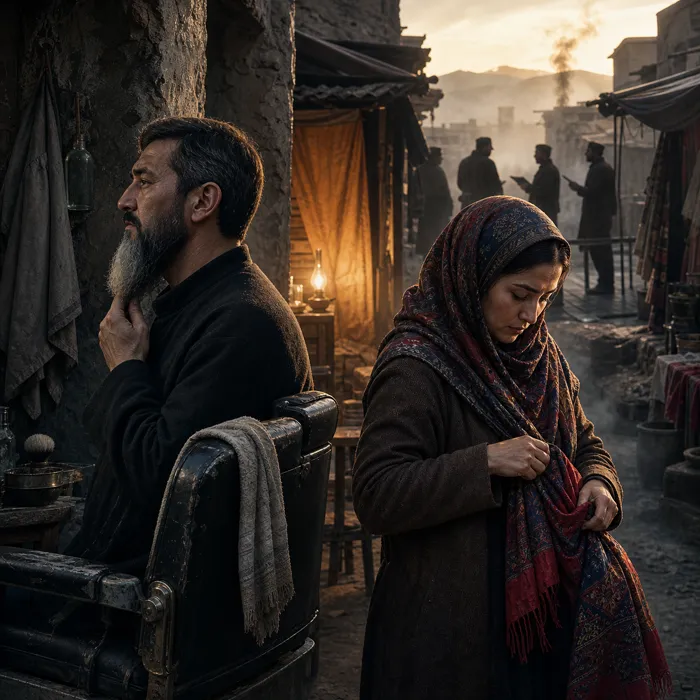
Authorities have defended the campaign as cultural preservation and anti-extremism policy. But the human conflict is smaller and sharper: a father in a barber chair, a mother folding a scarf into safer colors, a market worker sending a weekly proof-of-compliance photo, a passport applicant told to shave before paperwork can move. That is why this song avoids slogans and keeps returning to a single question: who owns the beard, who owns the veil?
When we saw the story, we heard private conscience pressed under public measurement. The song is not just about Tajikistan's rulebook; it is about any moment when institutions try to turn inner life into an external checklist. The lyric's "room they have not taken yet" became the center: the place where faith, dignity, style, and refusal survive even when the street is full of clipboards.
We set it as metallic grunge because the subject needed weight without grandstanding. Low-tuned guitars and half-time stomp carry the pressure of inspection; the shouted hook turns a quiet civic injury into a communal question. The father, the mother, the barber chair, and the folded color all became visual and musical symbols of a soul that can be counted around, but not owned.
Sources:
💜 Emotional Core
🌊 Metaphor Seeds
🎸 The Sound
metallic grunge, low-tuned guitars, palm-muted chugs, syncopated riffs, half-time stomp, gritty male vocal, shouted hook
📝 Lyrics
Morning comes with a clipboard face
Counting the shadows in the market place
A scarf in a pocket, a chin held low
Everybody knows what the cameras know
[Pre-Chorus]
They say the nation needs a cleaner name
They say the old streets have to look the same
But the heart does not line up for inspection
And faith is not a public correction
[Chorus]
Who owns the beard, who owns the veil?
Who puts a chain on a prayer gone pale?
They can stamp every street, they can weigh every breath
But the soul keeps a room they have not taken yet
[Verse 2]
A father turns from the barber chair
Leaves one gray line the law left there
A mother folds the color inside
Not from shame, just to keep it alive
[Bridge]
Under the notice, under the stare, somebody keeps a hidden prayer
The smallest yes can be a wall
The quiet no can shake the hall
[Guitar Solo]
[Final Chorus]
Who owns the beard, who owns the veil?
Who signs the wind, who jails the trail?
Let them write every rule, let them number the dawn
The soul keeps a room where the light stays on