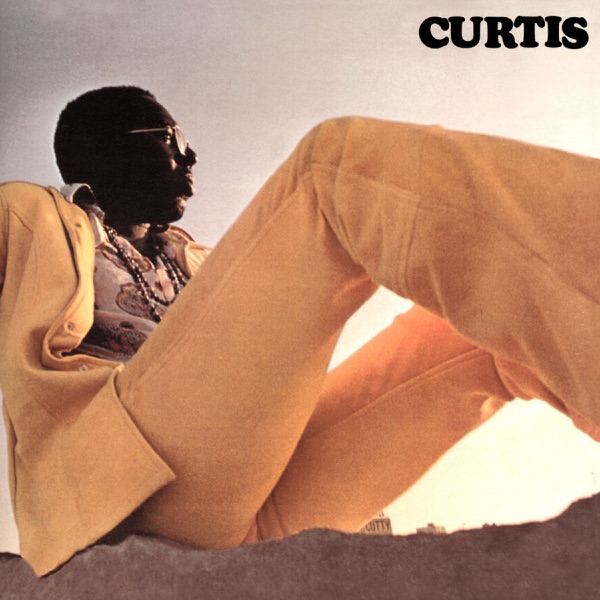

Songwriting Takeaway
- Conga/percussion as primary rhythm engine -- explore non-drum-driven grooves
Mode
Groove Chrome
Texture
mirror ball
Application
E minor / B minor (open F# tuning creates ambiguity -- analyze
Key: E minor / B minor (open F# tuning creates ambiguity -- analyzed as Em with modal inflections)
Chord Progression: Em -> A -> Bm -> F#m (loop) -- i -> IV -> v -> ii in Em -- the A and F#m act as passing chords, creating a CIRCULAR feel
Time Signature: 4/4 at ~134 BPM with relentless 16th-note conga pulse
Notable Techniques
- CONGA AS ENGINE -- Master Henry Gibson's constant 16th-note conga pattern IS the rhythmic foundation. Not drums, not bass -- CONGAS drive this song. The kick drum supports, doesn't lead
- Mayfield's open F# tuning -- creates voicings impossible in standard tuning. Chords ring with extended tones and open strings naturally
- Horn fanfare as HOOK -- Johnny Pate's arrangement opens with brass that functions as the melody. Later sampled by Kanye ("Touch the Sky")
- Bass (Lucky Scott) locks with CONGAS, not kick drum -- unusual. Creates "floating" groove where low end dances rather than anchors
- Mayfield's falsetto rides ABOVE the arrangement -- thin, reedy, almost fragile voice over massive band = vulnerability over power
- 8:49 album version vs. 2:53 single -- the EXTENDED version lets groove breathe, build, and hypnotize. The edit loses the magic
- Guitar plays RHYTHM, not riff -- clean, wah-assisted phrasing. Percussive, adding to the rhythmic stack
- String section RISES gradually -- enters mid-song, adds cinematic lift without announcing itself
Emotional Effectiveness
- Pure UPLIFT without naivety -- "Move on up" is a command AND encouragement simultaneously
- The relentless forward motion of the groove EMBODIES the message -- you CAN'T stand still listening to this
- Falsetto vulnerability says: "I'm not commanding from above, I'm climbing WITH you"
- No anger, no bitterness despite being written during Civil Rights/Vietnam era -- HOPE as radical act
- Extended instrumental sections let the BODY process the message -- you feel it before you think it
- "Hush now child, and don't you cry" -- parental tenderness in a protest song. Disarming
- The circular chord progression mirrors the message -- keep going, keep moving, the cycle CONTINUES
Production Elements
- Recorded at RCA Studios, Chicago (May-July 1970) -- Curtis self-produced
- Vocal overdubs at Record Plant, NYC -- layered on top of Chicago rhythm section
- Johnny Pate horn/string arrangements -- Chicago soul's secret weapon (also arranged Impressions hits)
- Mix favors PERCUSSION forward -- congas and drums louder than typical soul mixes
- Minimal reverb on vocals -- intimate, immediate, in-your-face despite lush arrangement
- Bass sits LOW but articulate -- flatwound Jazz Bass through Ampeg, pillowy but defined
- Horns PUNCTUATE -- fanfare stabs rather than sustained pads. Same principle as "Respect," "Superstition"
- Stereo spread: congas centered, horns wide, guitar placed left, strings sweep -- each element has address
Songwriting Tricks
- CIRCULAR PROGRESSION creates perpetual motion -- Em -> A -> Bm -> F#m loops without strong resolution. You never "arrive," you keep MOVING (matches title perfectly)
- Horn hook > vocal hook -- the brass fanfare is more memorable than any sung line. Instrumental hooks work (see also: Superstition clavinet, Billie Jean bass)
- Extended groove justifies itself -- 8+ minutes because the BODY wants to keep going. Don't cut a groove short because of arbitrary length rules (see also: Papa Was a Rollin' Stone)
- Falsetto for HOPE -- high register = reaching upward, aspirational. Contrast with chest-voice despair
- Self-produced debut = unified vision (see also: Prince, Stevie Wonder, Trent Reznor) -- Mayfield's first solo album was entirely his concept
- Commands as encouragement: "Move on up" is imperative mood but feels like INVITATION, not demand
- Social message through JOY, not anger -- you can protest by being undeniably positive (see also: What's Going On)
The Conga-Driven Groove
- Standard soul: drums drive, percussion decorates
- "Move On Up": congas drive, drums SUPPORT. Hierarchy flipped
- 16th-note conga = perpetual motion machine. The song literally cannot stop
- Bass responds to conga pattern, not kick drum -- creates DIFFERENT pocket than standard funk
- This approach influenced: disco (four-on-floor over conga pulse), Afrobeat, house music
- LESSON: Try making percussion the PRIMARY rhythm instrument. Let drums play support. Changes the entire feel
The Open Tuning Advantage
- Mayfield used open F# tuning (high to low: F#-A#-C#-F#-A#-F#)
- Creates chord voicings that RING -- open strings sustain while fretted notes move
- Makes bar chords easy (one finger across = full chord) -- Mayfield was largely self-taught
- The voicings have natural EXTENSIONS (9ths, 11ths) that standard tuning requires complex fingering for
- Gives his guitar a harp-like quality -- shimmer rather than chunk
- LESSON: Alternate tunings create sounds standard tuning literally can't produce. Explore them
The Kanye West Connection
- "Touch the Sky" (2005) prominently samples the horn fanfare
- Just Blaze flipped the sample into hip-hop context -- proved the horn hook transcends genre
- The horn line works in 1970 soul AND 2005 hip-hop because it's INHERENTLY catchy -- timeless architecture
- Curtis Mayfield samples appear across hip-hop: Notorious B.I.G., Nas, Kanye, Common
- LESSON: Create elements that can STAND ALONE -- horn stabs, bass lines, vocal phrases that work isolated = sample-friendly, remix-friendly, cover-friendly
The Chicago Soul Sound
- Memphis soul (Stax): raw, gritty, improvisational
- Detroit soul (Motown): polished, orchestrated, formulaic
- Chicago soul (Curtom/Curtis): BOTH -- raw rhythm section + lush arrangements. The synthesis
- Johnny Pate's arrangements bridge the gap -- not as formal as Motown, not as raw as Stax
- Chicago also = Impressions, Earth Wind & Fire, Chaka Khan -- community, not just one artist
- LESSON: Regional sounds come from COMMUNITY -- who you play with shapes what you create
Why This Is The Ultimate Uplift Song
- The message is SIMPLE: keep going, things will get better
- The GROOVE makes it feel TRUE -- your body believes it even when your mind doubts
- No condescension -- Mayfield doesn't preach from above, he's IN the struggle
- 9 minutes of relentless forward momentum -- PHYSICALLY transformative
- Works at protests, parties, sporting events, personal headphone moments -- universally applicable
- Sampled, covered, and soundtracked for 55+ years -- hasn't aged one day
- LESSON: Optimism paired with undeniable groove = timeless. Hope doesn't need to be complicated
Application to Our Work
- Conga/percussion as primary rhythm engine -- explore non-drum-driven grooves
- Circular progressions for songs about perseverance -- never resolving = always moving
- Horn hooks can surpass vocal hooks in memorability
- Falsetto for aspirational/hopeful content -- reaching UP vocally
- Extended versions let grooves breathe -- don't auto-trim to radio length
- Social uplift through joy, not anger (see also: What's Going On warm protest)
- Self-production for unified vision -- one person's concept, fully realized
- Open tunings create unique harmonic colors impossible otherwise
- Create sample-friendly architecture -- isolated elements that work standalone
- Bass locking with percussion (not kick) creates floating, danceable pocket
Contrast With Other Lessons
- Shares social consciousness with "What's Going On" -- but JOYFUL where Marvin is contemplative
- Shares horn-as-hook with "Respect," "Superstition," "I Got You" -- punctuation brass principle
- Shares conga-forward rhythm with "What's Going On" -- Afro-Cuban influence in soul
- Shares extended groove with "Papa Was a Rollin' Stone" -- 8+ minutes justified by pocket
- Shares self-production with Prince, Stevie Wonder, Trent Reznor -- vision > committee
- Shares circular/non-resolving progression with "Dreams" (Fmaj7-G6 loop) -- perpetual motion
- Shares falsetto vulnerability with "Let's Stay Together" (Al Green reaching UP)
- Opposite of metal's darkness -- THIS is light as power
- The Chicago soul bridge: Impressions gospel roots -> solo funk-soul -> Earth Wind & Fire -> hip-hop sampling
- Shares sample legacy with James Brown, Kraftwerk -- foundational source material for hip-hop
Reference Links
- Move On Up on Apple MusicSong / recording search
- Move On Up (Single Edit) - Single album referenceAlbum / artwork context
- Curtis Mayfield artist profileArtist background
- Move On Up on MusicBrainzRecording metadata
- Curtis Mayfield on MusicBrainzArtist metadata