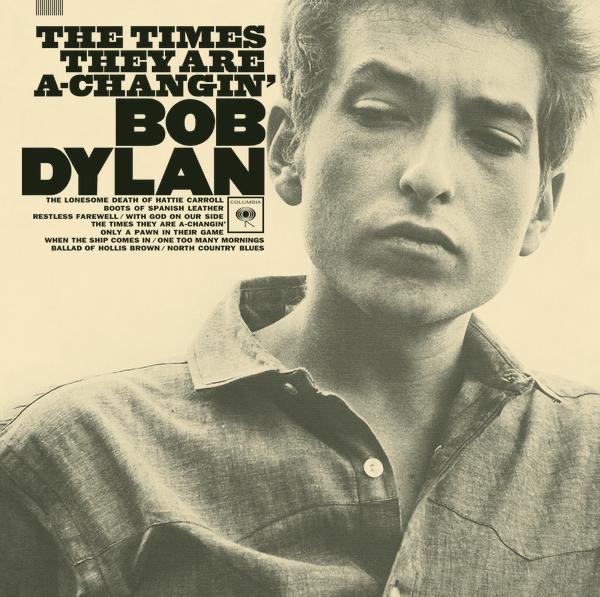

Songwriting Takeaway
- Strong fit for AI labor shifts, housing pressure, generational politics, climate adaptation, institutional trust collapses, sports-league changes, platform enshittification, or public backlash arcs.
Chord Progression Visuals
Genre lane: Country/Folk / protest folk. Chosen because the recent run is Soul/R&B (Otis Redding), Electronic (Depeche Mode), and Pop/Funk (Queen), so today should stay out of rock/metal and study a pure lyric-first folk mechanism.
Key: G major in common published/performing versions, though Dylan's delivery makes it feel more modal and austere than bright-major. The emotional color comes less from harmonic darkness and more from the warning tone, narrow melody, and biblical cadence.
Chord Progression / Harmonic Design
- Core verse loop is a plain folk progression around G, Em, C, D, and Am.
- A practical map: G -> Em -> C -> G, then C -> Am -> D, returning through G -> Em -> C -> G and C -> D -> G.
- Functionally, it is simple I-vi-IV-I / IV-ii-V / I-vi-IV-I / IV-V-I movement: familiar enough that the lyric can carry the weight.
- The vi chord gives a shadow under the major key; the IV and V keep the song public, declarative, and communal rather than private and moody.
Time Signature: 3/4 folk waltz. The triple meter is crucial: it gives the warning a processional, almost hymn-like walk. It does not stomp; it turns like a wheel.
Tempo / Feel: Moderate folk ballad pulse. The performance is not rushed, which makes the social urgency feel larger: the change is not panic, it is inevitability.
Notable Techniques
- Title as public notice: The hook sounds less like a personal confession than a sign nailed to a town square.
- Verse-by-verse audience targeting: Writers/critics, politicians, parents, and the public each get addressed. That lets one song cover a social shift without becoming a newspaper summary.
- Biblical/proverbial diction: Phrases feel old, almost scriptural, so a contemporary protest becomes archetypal.
- Water/current imagery: Change is framed as a force already moving. You can resist it, but you cannot negotiate with it.
- Plain melody, heavy implication: The tune is simple enough to sing after one listen. The complexity is in the social address.
- No named incident: The song becomes portable because it does not pin itself to one law, one politician, one protest, or one date.
- Escalating scope: Each verse widens the circle of responsibility. The song starts with observers and ends in generational reversal.
Emotional Effectiveness
This song works because it sounds inevitable rather than merely angry. Dylan does not beg the powerful to understand, and he does not explain the movement like a civics lecture. He announces that the ground has already moved.
The 3/4 pulse matters emotionally. A straight 4/4 protest song might feel like a march or argument. This waltz feel makes the change seem cyclical and historical, like seasons, tides, or scripture. The listener feels that the old order is not just being criticized; it is aging out.
The lyric also creates pressure by addressing people directly. It does not say "society is changing" in abstraction. It tells specific social roles how to behave: pay attention, move, do not block, accept that your children are beyond your control. That direct address gives the song teeth while the broad language keeps it timeless.
Production / Arrangement Elements
- Sparse acoustic guitar and harmonica keep attention on the words.
- Vocal is forward, nasal, and unsweetened; authority comes from conviction, not polish.
- Harmonica breaks function like punctuation between proclamations.
- The arrangement leaves almost no distraction. It trusts the lyric and cadence.
- The simplicity makes the song easy to inherit by crowds, covers, and movements.
Songwriting Tricks Applicable to Original Work
- If the topic is big, do not necessarily add more details. Add more addresses: who needs to hear this?
- Make the chorus a public notice, warning, or proverb rather than a private diary line.
- Use old-feeling language carefully when a modern story needs moral weight.
- Avoid timestamping the lyric unless the date itself is the point. Portability is power.
- Let each verse speak to a different stakeholder: witnesses, leaders, families, profiteers, victims, bystanders.
- For systemic stories, write the weather pattern, not the single raindrop.
- A simple waltz/folk progression can support a heavy message if the cadence is strong.
### Lyric Reverse-Engineering
1. What is the lyric really about underneath the surface?
Under the surface, it is about irreversible social turnover. The literal surface is a warning that conditions are changing, but the deeper subject is legitimacy: old authorities, old assumptions, and old hierarchies are losing their right to define reality.
2. Likely starting point
Likely title/phrase + social emotion + prophetic cadence. The title phrase feels like the seed: a proverb-like announcement that can be repeated after many examples. From there, Dylan likely built a roll call of audiences who needed to receive the warning.
3. Framing type
Mythic/protest address + reportage without specifics + proverb framing. It is topical in spirit, but not journalistic in detail. It turns a historical moment into a general law of motion.
4. How does the song avoid over-explaining?
It never lists the full political context. No legislative timeline, no named villains, no policy analysis. Instead, it uses command verbs, broad social roles, and elemental images. The listener understands the pressure because each verse tells another group: this is coming for your position too.
5. What approach could apply to trending-news songs?
For trending-news songs, use this when the real story is not one incident but a shift in the weather: AI changing work, a generation rejecting an institution, fans losing trust, climate consequences becoming normal, platforms decaying, or workers pushing back. Do not recap the article. Write the notice that different groups are forced to hear.
Reusable approach discovered: Public Notice Roll Call. Turn a systemic trend into a repeated warning addressed to several stakeholder groups. The hook is the notice; each verse names who must adjust.
Application to Our Work
- Strong fit for AI labor shifts, housing pressure, generational politics, climate adaptation, institutional trust collapses, sports-league changes, platform enshittification, or public backlash arcs.
- Example: instead of "companies are adopting AI and workers are anxious," write a folk/gospel warning with verses to managers, coders, customers, and students. The chorus does not explain the technology; it says the old map no longer holds.
- Production direction: acoustic or restrained roots arrangement, 3/4 or 6/8 pulse, plain vocal, minimal percussion, and a hook that feels like a sentence people would repeat at a meeting, picket line, or kitchen table.
Practice Prompt
Pick one trend headline. List four groups affected by it. Write one verse-address to each group using only commands, images, and consequences. Make the chorus a short public notice, not an opinion. If the song can survive without naming the headline, the frame is working.
Reference Links
- The Times They Are A-Changin' on Apple MusicSong / recording search
- Bob Dylan artist profileArtist background
- The Times They Are A-Changin' on MusicBrainzRecording metadata
- Bob Dylan on MusicBrainzArtist metadata