📖 The Story
The Story: On March 31, 2026, Netflix released "Untold: The Death & Life of Lamar Odom," a documentary tracing the two-time NBA champion's lifelong battle with loss, addiction, and a death that has stalked him since childhood. The 46-year-old, now approaching 60 days sober, opens up about trauma, near-death, and the long road back.
Death found Lamar Odom early. His mother, Cathy Mercer, died of colon cancer when he was twelve. His father, Joe Odom, was a heroin addict who left his son to be raised by his grandmother in Queens, New York. Despite the wreckage of his childhood, Odom became one of the most versatile forwards in NBA history — winning back-to-back championships with the Los Angeles Lakers in 2009 and 2010 and earning the Sixth Man of the Year award in 2011.
But the shadows never left. On October 13, 2015, Odom was found nonresponsive at the Love Ranch, a brothel approximately 80 miles outside Las Vegas. "They need to hurry, please," a caller begged 911, "because he's got blood hanging out of his nose, white stuff coming out of his mouth. They can't get him to wake up." He was placed on life support and fell into a coma. He suffered 12 strokes and six heart attacks. Doctors said he would never walk or talk again.
His ex-wife Khloé Kardashian, who had signed divorce papers just before the incident, stayed by his side. When his own father wanted to take him off life support, Kardashian refused. "Through sickness and health, I have to be there for him," she said. Kobe Bryant helped her decide on a high-risk lung surgery with "like a 10% chance it will work." It worked. Three days after flatlining, Odom woke up. He defied every prediction.
Now, a decade later, Odom is still fighting. He completed a 30-day rehab stay in February 2026, following a DUI arrest in Las Vegas the month prior. "It's like swimming in a cesspool of trauma," Odom told USA TODAY about revisiting his past. "But I just know I'm bigger than the situation, and I hope to help a lot of people by giving my testimony."
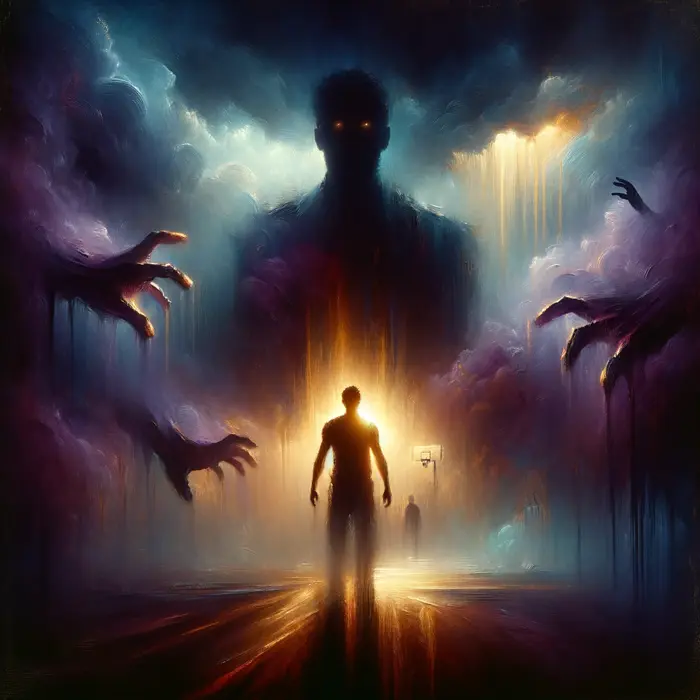
When we found this story, we didn't hear a celebrity tabloid — we heard a universal pattern: death circling someone since childhood, and that person refusing to stop getting up. The line "Won the game but never beat the loss" became the thesis — a championship winner who could never outrun grief. We wrote it as a dark blues rock slow burn because the genre IS defiance against darkness: heavy, gritty, raw. The bridge — "I've been both the needle and the arm / Both the prayer and the one doing harm" — captures addiction's impossible duality. This isn't about Lamar Odom. It's about anyone who's felt death hunting them, and kept saying no.
Sources:
🔗 Sources
💜 Emotional Core
🌊 Metaphor Seeds
🎸 The Sound
This story sounds like a heavy blues dirge — death circling slowly, closing in, but the man keeps getting back up. Electric piano, muted trumpet, and organ layered over heavy groove and droning bass. Raspy baritone vocals with gritty, confessional delivery. Sparse-to-full dynamics mirror the resurrection arc — from intimate whispered verses to a cathedral-reverb gospel choir on the final chorus. Southern gothic undertones with a relentless pulse that never lets up, like death's footsteps behind you.
🔧 Techniques Used
✍️ Lyrical Style
- Repetition as defiance — "Death kept calling" hammered home as refusal
- Parallel structure — "Both the needle and the arm / Both the prayer and the one doing harm"
- Physical resurrection imagery — ripping the sheet off, clawing back out
- Specificity without naming — "coffin built for bliss" captures the brothel without saying it
Confessional gospel-blues storytelling. Every verse builds a case for why this man should be dead — and the chorus defies it. The bridge's dual identity lines ("both the needle and the arm") capture addiction's impossible truth with devastating precision.
🎶 Music Lessons Used
📝 Lyrics
Death came knocking when I was twelve
Took my mama, left me by myself
Daddy chose the needle, chose the vein
Left a boy to outrun grown-man pain
Stacked the grief until it was a cross
Won the game but never beat the loss
Every time they put me in the ground
Something in me clawed back out
Death kept calling but I didn't go
Death kept calling but I'm still here though
They drew the sheet across my face
But I ripped it off and took my place
Death kept calling — I kept saying no
Champagne pouring while the demons wait
Standing ovation but the floor's a cage
When the crowd goes home the silence screams
Traded daylight for a velvet room
Laid my body in a stranger's tomb
Woke up in a coffin built for bliss
Three days under, death's last kiss
Death kept calling but I didn't go
Death kept calling but I'm still here though
They drew the sheet across my face
But I ripped it off and took my place
Death kept calling — I kept saying no
They say the ones who live too long
Become the villain in their song
I've been both the needle and the arm
Both the prayer and the one doing harm
But I'd rather be the ghost who stayed
Than the legend rotting in the shade
Death kept calling and I almost went
Death kept calling but I'm not done yet
Sixty days of breathing like it's new
Every sunrise something death can't undo
Death kept calling — I'm still here