📖 The Story
The Story: On May 7, 2026, Science News reported on a Cell Reports study showing that after people trained to fly with virtual wings, parts of their visual cortex began responding to images of wings more like they respond to real upper limbs.
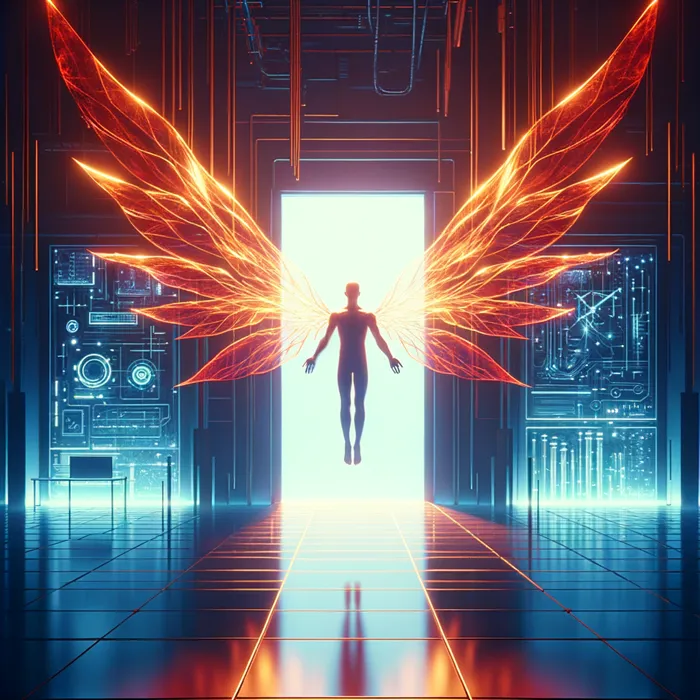
The experiment followed 25 participants through a four-session, weeklong VR training program. Wearing headsets and motion-tracking gear, they saw themselves in a virtual mirror as birdlike bodies with large rust-colored wings. Their wrists and arms controlled the wings, turning ordinary human motion into a new kind of flight control.
The training was not just decorative immersion. Participants knocked away falling airballs, stayed airborne over steep cliffs, and steered through rings. Science News quoted neuroscientist Ziyi Xiong explaining that some people learned on the first try while others needed three or four sessions, but improvement was visible across the group.
After training, researchers found stronger neural responses to wing images in visual-cortex areas normally associated with body-part perception. Yanchao Bi of Peking University told Science News that participants began seeing the wings as part of their own bodies, pointing to a broader boundary for brain plasticity than many people imagine.
The study also circulated through science and technology coverage beyond the original report. Antyweb summarized the experiment as evidence that the brain does not treat the body's border like an immovable wall, while Cell Press highlighted the paper under the title “Virtual flying experience changes neural responses to seeing wings.”
When we saw this story, the emotional core was not simply “VR is cool.” It was the shock of discovering that identity is more flexible than habit says. The body’s edge can move. A strange new appendage can stop feeling like costume and start feeling like possibility.
We wrote Skin for the Sky as neon synth-rock because the story needed both machinery and lift: pulses, wires, laboratory light, then a chorus that opens like air. The song turns the study’s mirror, wings, rings, and brain scans into a human question: what else have we called impossible skin just because we had never learned to live inside it?
Sources:
💚 Emotional Core
🌊 Metaphor Seeds
🎸 The Sound
Make the science feel like first flight: pulsing synthetic motion underneath human rock vocals, then a chorus that opens like a body discovering another room inside itself.
🔧 Techniques Used
✍️ Lyrical Style
The lyric treats VR wings as a metaphor for discovering that selfhood is more flexible than habit says.
📝 Lyrics
They gave me a mirror with no mercy in it
A stranger with feathers where my shoulders ended
Rust-red wings in a laboratory light
I laughed like a prisoner seeing keys for the first time
I turned my wrists and the weather replied
The fake blue opened with a real fear inside
Skin for the sky, teach me to turn
Let every locked impossible burn
I borrowed wings till the wings borrowed me
Now the edge of my body is a door to the sea
Twenty-five hearts in a room full of wires
Missing the rings, then rising higher
Some learned in a morning, some needed the week
But the brain loves a language the bones cannot speak
And when the pictures came back on the screen
The wings looked almost like my hands to me
Skin for the sky, teach me to turn
Let every locked impossible burn
I borrowed wings till the wings borrowed me
Now the edge of my body is a door to the sea
What else have I called impossible skin
Just because I had never been living in it?
The cage has a habit, the map has a scar
But the self keeps rooms for what we are
Skin for the sky, teach me to turn
Let every locked impossible burn
I borrowed wings till the wings borrowed me
Now the edge of my body is a door to the sea
Skin for the sky, nerve for the blue
I learned a new limb and it learned me too