
Songwriting Takeaway
- Chromatic bass walks add sophistication to simple progressions (see also: Ms. Jackson, Billie Jean pedal bass)
Mode
Sample Cut
Texture
crate dust
Application
Bb major
Key: Bb major
Chord Progression: Bb -> G7 -> Cm -> F7 (verse) -- I -> V7/ii -> ii -> V7 with jazz-influenced chromatic movement; bridge lifts to Eb -> Ebm -> Bb -> G7 -> Cm -> F7 -- the Ebm (biv minor borrowed chord) is the GUT PUNCH moment
Time Signature: 4/4 with slow, swinging ballad feel -- 12/8 implied triplet shuffle
Notable Techniques
- Written by Willie Nelson at 27 -- demo was so rough (Willie's nasal delivery) that Patsy initially REFUSED to record it. Producer Owen Bradley convinced her. Willie's demo = sketch, Patsy's version = masterpiece
- Vocal control as emotion -- Patsy's vibrato is WIDE on sustained notes, tight on quick phrases. The VARIATION conveys instability (she's "crazy," after all)
- Falling melody on "crazy" -- the word literally DESCENDS in pitch. Word painting: she's falling apart, melody falls too
- Nashville Sound production -- strings + background vocals replace honky-tonk instruments. Country going UPTOWN
- Walk-down bass line (Bb -> A -> Ab -> G) in intro -- chromatic descent = melancholy in motion before a word is sung
- Piano (Floyd Cramer) plays "slip note" style -- grace notes that slide INTO the target note. Signature Nashville technique
- NO drums on original -- rhythm comes from bass walk and piano only. Radical restraint
- Vocal phrasing BEHIND the beat -- Patsy drags slightly, creating ache. Each word savored, not rushed
Emotional Effectiveness
- "Crazy for trying, crazy for crying, crazy for loving you" -- the THESIS in one line. Three "crazy for" phrases escalate: trying -> crying -> loving. Logical sequence of heartbreak
- Self-blame as subject -- she's not angry at HIM, she's calling HERSELF crazy. Vulnerability without accusation
- The borrowed chord (Ebm) in bridge = the moment everything HURTS. Major song, one minor borrowing = devastating contrast
- No resolution -- she's STILL crazy at song's end. No "but I'll be fine." Sits in the pain
- Simplicity of language -- "I knew you'd love me as long as you wanted" = plain words, devastating meaning
- Nelson's songwriting + Cline's delivery = greater than either alone. The INTERPRETATION exceeds the composition
Production Elements
- Recorded at Bradley Film & Recording Studio, Nashville (the famous Quonset Hut)
- Owen Bradley producing -- architect of the Nashville Sound
- The Jordanaires on backing vocals -- same group that backed Elvis. Smooth "oohs"
- Strings arranged to SWELL, not sustain -- they breathe with the vocal phrases
- Mix is WARM -- tube recording chain, natural room reverb from the Quonset Hut
- Vocal sits FORWARD and dry -- close-mic intimacy. You hear every breath
- Bass (Bob Moore) plays quarter notes, walks chromatically -- metronome AND melody simultaneously
- Piano fills BETWEEN vocal lines -- never competes, always comments
Songwriting Tricks
- CHROMATIC BASS WALK = instant sophistication -- Bb -> A -> Ab -> G descends by half-steps. Smooth, inevitable, melancholy (see also: Ms. Jackson descending bass)
- Escalating parallel structure: "crazy for trying / crazy for crying / crazy for loving" -- rule of three with emotional build
- BORROWED CHORD (biv minor) -- Ebm in a Bb major song. One chord from the PARALLEL MINOR sneaks in. Creates momentary darkness in bright key. Devastating
- Self-blame > accusation for heartbreak songs -- calling yourself crazy = vulnerability, calling THEM crazy = bitterness
- Plain language for big emotions -- "I knew you'd love me as long as you wanted" needs no metaphor
- Falling melodic intervals on key emotional words -- "crazy" descends, mirrors emotional collapse
- NO drums = intimacy. Not every song needs percussion
- Let the SINGER transform the song -- Nelson's version is a sketch, Cline's is the painting
The Borrowed Chord Lesson (biv minor)
- Key of Bb major -- Eb major (IV) is diatonic, expected, comfortable
- Eb MINOR (biv) borrowed from Bb MINOR (parallel minor) -- one note changes: Gb instead of G natural
- That Gb note clashes with the major key expectation -- creates instant ACHE
- Used by: Radiohead ("Creep" -- the famous G to G# chord), Beatles ("In My Life"), countless ballads
- Only needs to appear ONCE for maximum impact -- overuse dilutes it
- LESSON: Borrow ONE chord from the parallel minor for your gut-punch moment. Save it for the bridge or pre-chorus
The "Slip Note" Piano
- Floyd Cramer's signature: grace note slides UP to the target note
- Creates "crying" effect on piano -- mimics steel guitar bends
- Became THE Nashville piano sound of the 60s
- Simple technique, massive emotional impact
- LESSON: Ornamental notes (grace notes, slides) add humanity to keyboard parts. Don't play "straight"
The Owen Bradley / Nashville Sound
- Before Bradley: country = fiddle, steel guitar, twang. Niche audience
- After: strings, smooth vocals, pop accessibility. Country crossed over to pop charts
- "Crazy" hit #2 pop, #2 country -- DUAL chart success
- The formula: keep the emotional TRUTH of country, dress it in pop sophistication
- Critics called it "countrypolitan" -- purists hated it, audiences LOVED it
- LESSON: Genre crossover happens when you keep the SOUL and update the SOUND
Why Patsy's Version Wins
- Willie Nelson's demo: nasal, rhythmically loose, almost conversational
- Patsy Cline's version: controlled vibrato, perfect pitch, ACHE in every syllable
- She initially hated the song -- thought it was "a man's song"
- Owen Bradley: "Sing it your way, Patsy." She did. It became her signature
- The lesson: RESISTANCE to material doesn't mean it's wrong. Trust the producer/collaborator
- LESSON: The best version of a song might come from someone who didn't write it
The Three-Part Escalation
- "Crazy for TRYING" -- action (still doing something, still hoping)
- "Crazy for CRYING" -- reaction (the trying failed, now there's pain)
- "Crazy for LOVING you" -- root cause (the whole problem, stated last)
- Each phrase goes DEEPER: surface -> symptom -> disease
- This is RHETORIC -- classical persuasion structure in a country song
- LESSON: When listing in a hook, ORDER MATTERS. Escalate from surface to core
Application to Our Work
- Chromatic bass walks add sophistication to simple progressions (see also: Ms. Jackson, Billie Jean pedal bass)
- Borrowed chords from parallel minor = instant emotional depth (one is enough)
- Self-blame in heartbreak songs = more vulnerable than accusation (see also: Jolene, Always on My Mind)
- Plain language beats poetic obscurity for direct emotional impact
- Falling melodic intervals on emotional keywords = word painting
- Escalating parallel phrases in hooks -- "crazy for X / crazy for Y / crazy for Z" pattern
- Songs don't need drums -- intimacy through restraint
- The INTERPRETER can surpass the writer -- collaboration > solo vision sometimes
- Slip notes / grace notes add crying quality to piano/keys
Contrast With Other Lessons
- Shares self-blame with "Jolene" (Dolly admits her weakness) and "Always on My Mind" (Willie admits his failures) -- vulnerability pattern
- Shares chromatic bass descent with "Ms. Jackson," "Billie Jean" -- melancholy in motion
- Shares Nashville production with "Folsom Prison Blues" -- but opposite approach (Bradley = smooth, Phillips = raw)
- Shares "interpreter > writer" with "Respect" (Aretha > Otis) and "Always on My Mind" (Willie > Elvis)
- Shares no-drums intimacy with "Ain't No Sunshine" (minimal percussion) and "Dock of the Bay" (light drums)
- Shares borrowed chord technique with Radiohead, Beatles -- universal emotional device
- Willie Nelson connection: HE wrote this, WE studied his "Always on My Mind." Same songwriter, different role
- Shares plain-language power with "Ain't No Sunshine" ("she's gone") and "Let's Stay Together" ("I'm so in love with you")
Reference Links
- Crazy on Apple MusicSong / recording search
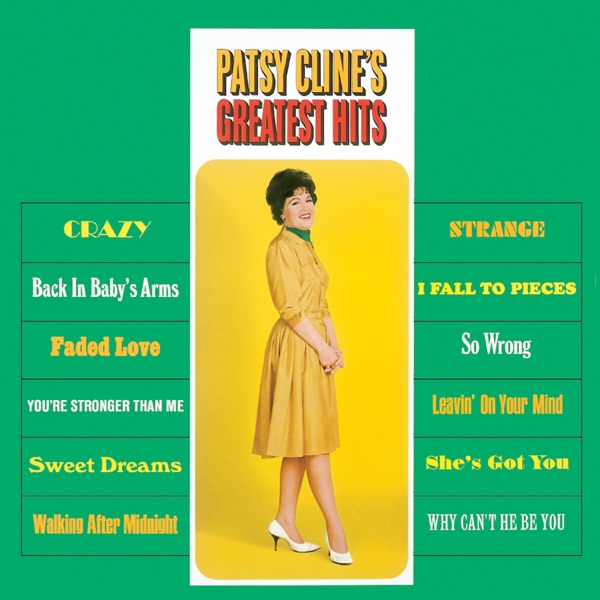
- Patsy Cline's Greatest Hits album referenceAlbum / artwork context
- Patsy Cline artist profileArtist background
- Crazy on MusicBrainzRecording metadata
- Patsy Cline on MusicBrainzArtist metadata